
WRITER : ISHA CHAUDHARY
EDITOR : SHIVRAJ PATEL
Korea’s remarkable economic transformation from a colonial nation to a global powerhouse tells a story of strategic trade and industrial policy. Since the late 1960s, South Korea has pursued an export-led growth policy, which fueled its economic development and gave rise to what’s often called the ‘Miracle on the Han River’. Initially, this strategy involved government intervention and the promotion of labor-driven industries like textiles, fishing, and handicrafts. Over time, the focus shifted to high-value sectors, leading to the rise of internationally competitive companies like Samsung, Hyundai, and LG.
Today, Korea’s trade strategy is a blend of multilateral agreements, technological innovation, and a continuous effort to unite its partners through different geopolitical landscapes.
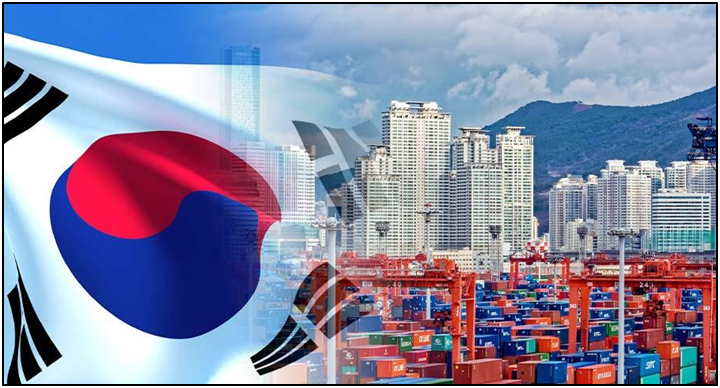
Picture Credit : Kaohoon international report
The Historical Foundation of Korean Trade
In the aftermath of the Korean War, South Korea was one of the poorest countries in the world, with a GDP of 64 dollars. The country’s early trade policy was marked by an import system, but this soon gave way to a shift toward exports to international companies. Under the governmental rules of President Park Chung-Hee, a series of five-year economic development plans were implemented all over the country. Under this, the government provided some subsidies, tax breaks for some period of time, and cheap financing to export-oriented firms to maintain the economy. This strategy, as a result, not only boosted exports but also fostered many manufacturing bases, which grew from 14% of the GDP in 1962 to over 30% by the late 1980s, signifying the highest growth in human history.
The government also pushed for heavy and chemical industries (HCI) in the 1970s, which was a critical turning point. It prioritized shipbuilding, steel, electronics, and the automobile industry. Supported by strong state guidance and a nationalistic focus, it helped the country climb and build technological capabilities. By the late 1980s, Korea was exporting 50% of electronics and cars.
The economic relationship between North and South Korea has a unique history. While political tensions have often halted their cooperation, there have been periods of limited exchange, particularly in the 1990s and 2000s, with projects like the Kaeseong Industrial Complex serving as a symbol of economic collaboration. However, due to political and security issues, intra-Korean trade has been sporadic and remains heavily restricted due to political and security tensions in North Korea.
How Korea Trades with the World (Extra-Regional)
Today, Korea’s trade strategy is focused on a few key areas:
- Technology: Korea is a global leader in making things like semiconductors (computer chips), smartphones, and high-tech TVs. These are very valuable and a huge part of their exports.
- Trade Agreements: Korea has signed many Free Trade Agreements (FTAs) with big economies like the United States and the European Union. These agreements make it cheaper and easier to sell their products in those countries by removing taxes on their goods.
- Research: Korea invests a lot of money in research and development (R&D). This helps them create new, advanced products that other countries want to buy, keeping them ahead of the competition. For example, the GKS scholarship also gets 50% funding for the R&D program.
How Korea Trades with Its Neighbors (Intra-Regional)
Within Asia, Korea has a clever strategy to balance its relationships with its neighboring partners:
- Balancing Act: While China is its biggest trading partner, Korea is actively trying to trade more with other countries in Southeast Asia, like Vietnam, India, and Indonesia. This is a way to reduce its dependence on just one country.
- Joining Hands: Korea is a key member of a huge regional trade deal called RCEP (Regional Comprehensive Economic Partnership). This agreement helps make trade rules the same across many Asian countries, which is great for business.
- Supply Chains: Korea’s factories are a vital part of the supply chain for many products made in Asia. For example, a phone made in Vietnam might have a Korean-made computer chip inside it. This makes Korea an essential partner for its neighbors, which is like getting a sole first before getting shoes.
Share it with Your Friends & Family :