
WRITER : HARDESH NARANG
EDITOR : SHIVRAJ PATEL
Democracy is presently world’s most followed system to govern a country and maintain law and order in it. South Korea has also been a democratic country. So today we will discuss the rise of democracy in south Korea and how is power divided in the government to maintain law and order in the country. Along with that we will also see how is south Korean political system different from that of India.
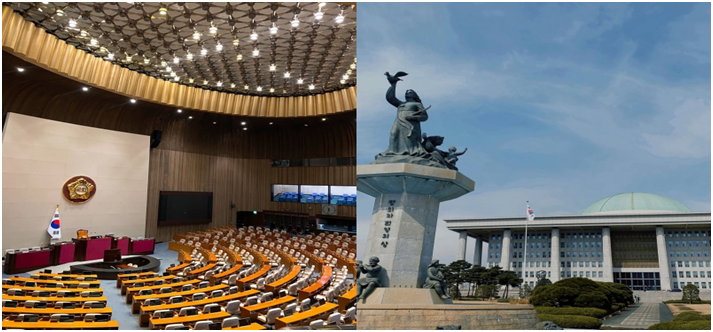
(credit-Korea.net)
South Korea is a presidential republic which means The President is both the Head of State and Head of Government. Strong executive powers are concentrated in the hands of the President. But a single president cannot control a country he needs help from different people of his nation to contribute to law making and enforcing with a complete power to challenge policies and demand justice. Thus, the power is divided in a system called ‘The organs of the government’. There are three major organs of government in south Korea: –
- The Legislative is the part of government which is responsible for making laws, auditing the budget of the country, maintaining relations between the states of the nation and with other nations. it is Derived from the sovereignty of the people (through elections) and thus is accountable to its people. In south Korea, the legislature is unicameral (controlled by only one house) and is controlled by the national assembly of Korea. The head of the national assembly is the speaker of the national assembly. There are 300 members in the national assembly out of which 253 members are elected through direct election which takes place every 4 years and rest 47 seats are filled from proportional representation.
- The Executive are responsible for enforcing the policies and laws made by the legislature. The head of the executive is the president of the south Korea who is also the head of state and government. Other members of the executive include the prime minister (who is the vice chairman of the executive and is appointed by the president with the agreement of national assembly) and 18 ministers which form the state council. The executive has a tenure of 5 year and president is elected from polarity election and cannot be re-elected.
- The Judiciary is the organ of government that interprets laws, protects rights, and ensures justice. the south Korean judiciary is divided in multiple levels which includes the Supreme Court which is the highest form of court for civil, criminal, and administrative cases. Other level of courts includes High Courts, District Courts, Family Courts, Military Courts. South Korea also has a special type of court called the constitutional court which deals with constitutional disputes, impeachment trials, bans political parties if unconstitutional.
As we know, India follows a federal system for vertical division of power between Union and States by the Constitution, but the Union has overriding authority in many cases. But south Korea follows a unitary system where all powers are centralized with the national government. Local governments exist but with limited autonomy. Their powers are delegated by the central government, meaning the National Assembly and President can decide how much authority local bodies get.
South Korea has a presidential form of government, where the President is both the Head of State and Head of Government with significant powers, while India has a parliamentary system, where the President is largely ceremonial and real authority rests with the Prime Minister and Council of Ministers. South Korea follows a presidential system with clear separation of powers, whereas India a system which makes the executive accountable to the legislature. The legislature in South Korea is unicameral with only the National Assembly, while India has a bicameral parliament consisting of the Lok Sabha and Rajya Sabha. In terms of the executive, the South Korean President is directly elected by the people for a single non-renewable five-year term, whereas the Indian President is indirectly elected for five years (re-election possible), and real power lies with the Prime Minister. Elections in South Korea involve direct voting for the President and a mixed system for the National Assembly, while in India the President is indirectly elected and the Prime Minister emerges from the majority in the Lok Sabha, which is elected by the first-past-the-post system. The judiciary in South Korea is independent with a Constitutional Court having powers of constitutional review and impeachment trials, while India’s judiciary is led by the Supreme Court, which exercises judicial review but impeachment is handled by Parliament.
Now its clear to us that although south Korea and India both are democratic republics but their method to practice it differs from one another and this had never strained the relations between the two nations. and with that being said we will end our topic here.
Share it with your family and friends: