
Writer: HARDESH NARANG
Editor: SHIVRAJ PATEL
South Korea established democracy in 1988 which marked the beginning of sixth republic of south Korea since its liberation from Japan in 1945. At that time, South Korea and North Korea were divided. South Korea alternated between aristocracy and liberal democracy. Today we will be discussing about the first republic of the south Korea, where we will talk about how it started, its system, contribution, challenges, important events and its downfall.
So after the liberation of Korea from Japan, a conference was held in Moscow, In December 1945, and a US-Soviet joint commission was established. The commission met in Seoul but deadlocked over the issue of establishing a national government. In September 1947 Korean issue was passed on to the UN General Assembly.
The First Republic of South Korea marks a critical phase in Korean history, as it laid the foundation for the modern South Korean state. After end of the Japanese colonial rule and the cold war; on 15 August 1948, the first republic of south Korea rose with Syngman Rhee as the president. At the first glance the first republic was seen as the representation of sovereign spirit of south Korea but instead it was characterized by authoritarianism, economical challenges and collisions between different ideologies.
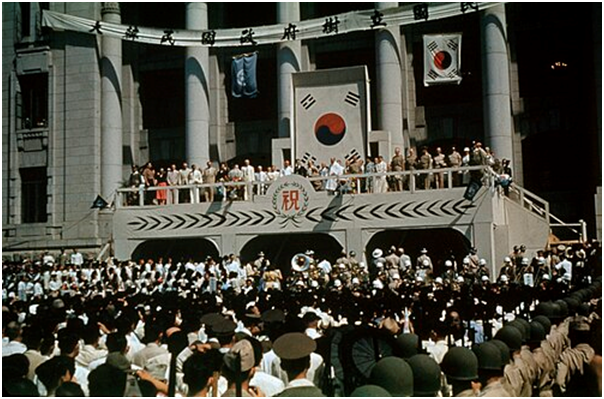
Credit- Wikipedia.org
A presidential system of government was adopted by south Korea (as in united states) but it was highly controlled by the president and was immensely authoritarian. The president Syngman Rhee often disregarded the democratic principles to establish his power and influence over the whole south Korea; to extend his presidency and weaken the parliament’s power, amendments were made in the constitution which also suppressed the opposition political parties leading to political disagreement.
Rhee leaded the country with his strong anti-communist ideology. To gain international support, his government created its image as a savior which would protect the people of South Korea against the north Korea’s growing threat to reclaim the land. But in the inside, same approaches were used to silence the voices and questions of the students, activists and opposition.
The most disturbing event during the Rhee’s reign was the Korean war (1950-53). on 25 June 1950, north Korea made its attempt to reclaim the land and unify the peninsula under communist rule. But with the help of international alliances, south Korea was able to overcome this crucial challenge but the peace came at an immense loss of both material and human resource. The war left both the countries in a devastated and damaged state filled with causalities.
1953’s Armistice agreement led to the end of the war, but the tension between the two nations continued to grow. The peninsula remained divided, and both the countries were in great distress economically. South Korea had to rely on American military and economic support to get back to its feet. The war somehow made Rhee’s argument about power being centralized for national security, stronger, allowing him to continue his rule.
The motion against the Rhee’s government grew drastically by the late 1950s. his government of allegedly accused of doing fraud in elections, enforcing censorship and increasing corruption; these accusations fueled the public’s rage. During the march 1960 election, Rhee won but people believed that his winning was the result of misconduct in election and declared that the result was unfair.
When the people began to understand the authoritarian rule of Rhee’s government and started demanding democratic rights by organizing protests, it escalated a nationwide movement and led to a struggle which was named as April revolution in the history of south Korea. On 19 April 1960, the protests grew and police began the open fire on student bodies protesting in Seoul, which led to the demise of multiple students and enraging the country’s citizens. Faced with growing pressure and treats, Rhee decided resign on 26 April 1960 and flew away into exile in Hawaii.
This led to the collapse of The First Republic, giving way to the Second Republic of South Korea, which briefly attempted a parliamentary system before being taken control by a military coup in 1961
The first republic of south Korea is like a bitter-sweet memory in the nations heart. On one side, it portrays south Korea’s birth as an independent and sovereign nation laying the footsteps for the political and administrative system of the country. However, on the other side, it was a rule of authoritarian with limited democratic liberation. The rule was corrupt and left the nation to rely on the foreign aid. While the First Republic ended in turmoil, it gave the way to South Korea’s long struggle toward becoming a democratic nation and development in the decades to follow.
Share it with your family and friends: