
WRITER : PRACHI SHARMA
EDITOR : SHIVRAJ PATEL
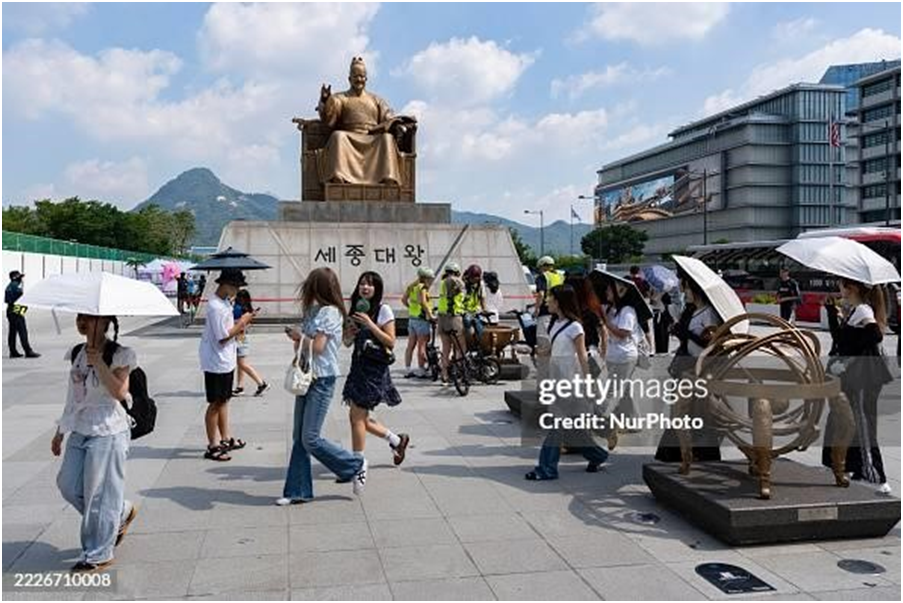
This year, South Korea has experienced its worst heat ever. It was not just unbearable weather but a clear indication that the climate crisis is getting worse. This heat, which lasted for several weeks, exhausted big cities like Seoul and Busan. The situation was such that there was no relief from the heat even at night. The number of patients suffering from heatstroke and dehydration increased in hospitals, farmers were worried about their critical decisions and crores of people became dependent on air conditioning to survive as the demand for electricity reached record levels. The impact of this heat has been felt on every part of society-from health to agriculture and energy-reminding us that climate change is not a future threat but today’s reality. This record-breaking heat is not just a test of patience for the people of South Korea but a warning to the entire world that action is now urgently needed.
Picture Credit: NurPhoto on gettyimages
This year the heat broke all records in South Korea. The long heatwave that lasted for several weeks affected people’s daily lives a lot. It was so hot during the day that people were avoiding going out. The biggest problem was that there was no relief from the heat even at night. In big cities like Seoul, Busan and Daegu, the roads, buildings and cement would absorb so much heat that the whole city would look like a “furnace”. People felt as if they were living inside a fire day and night.
Heatwave Poses Serious Health Risks, Especially for Vulnerable Groups
In South Korea, the heat had the greatest impact on people’s health. Cases of heatstroke, dehydration and blood pressure increased significantly in hospitals. The elderly, small children and people who work outside all day, such as construction workers or delivery workers, suffered the most. In many places people started losing consciousness and needed immediate medical help. Its effect was not just on physical health, but on mental health too. People became dizzy due to the heat, could not sleep properly and felt very tired. All this shows that extreme heat is not just a weather problem but has become a health emergency.
Power Demand Soars, Raising Concerns Over Blackouts and Energy Stability
During this record-breaking heat, the demand for electricity in South Korea reached its highest level. AC, cooler and fridge started running continuously in every household, which put a lot of load on the power grid. In some cities, emergency measures had to be taken to manage the electricity supply. If the demand continues to increase like this then the risk of blackout and power cut could increase even more. This energy crisis has shown that during extreme heat, not just health and farming but the entire infrastructure of the country also comes under pressure.
Urban Heat Island Effect Makes City Nights Nearly as Hot as Days
In South Korea’s big cities like Seoul, Busan and Daegu, the heat is felt more because these cities are full of concrete buildings, roads and traffic. During the day all these surfaces absorb the sun’s heat and release it slowly at night. Because of this even at night the temperature remains high and people do not feel the cold. This is known as the “urban heat island effect”. While in villages and small areas there is mild coolness at night, in the cities people live under the pressure of heat day and night. This effect makes life in cities more difficult and puts extra load on both health and energy demand.
This Summer’s Heatwave Highlights the Ongoing Threat of Climate Change
This record-breaking summer in South Korea is not just a seasonal event, but a big indication that climate change is still happening. The temperature is increasing every year and natural disasters like heatwaves, floods and typhoons are becoming more powerful. Scientists say that if greenhouse gases and pollution are not controlled, the heat could become even more dangerous in the future, which will become a challenge not just for South Korea but for the whole world. This summer is giving us a stark warning that if we want to save our future, it is very important to take action now. It reminds us that protecting the environment is no longer a choice, but a necessity.
Government Launches Emergency Measures to Protect Public Health and Agriculture
The South Korean government took several steps to deal with the heat. Flexible school and office hours were set up so that people would not have to go out in the hottest midday sun. Hospitals were provided with extra staff and “cooling centers” were set up where people could go to get some relief. Efforts were made to provide water and essential supplies to farmers, and constant monitoring was started to keep the power supply stable. The government also explained to people through awareness campaigns how to save energy at home and take care of their health.
Scorching Heatwave Reminds Us: It’s Time to Act Together Against Climate Change
This year’s record-breaking heat in South Korea isn’t just weather news; it’s a clear warning of how real and dangerous climate change has become. The heatwave has had a deep impact on people’s health, farming, economy and daily life. In times like this, not just the efforts of the government are enough, but every citizen will have to understand his or her role – whether it is saving energy, reducing pollution or adopting environment-friendly habits. If steps are taken now, we can reduce the impact of such extreme heat in the future.
Share it with your Family & Friends :