
WRITER: AREEBA SHAFEEQ
EDITOR: PRACHI KANSHWAN
CREDIT: PINTEREST
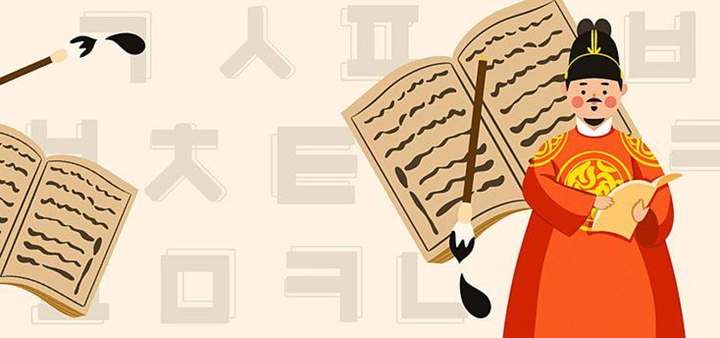
In the canvas of Korean history, few of the moments shine as brightly as the stars in a deep sky, the invention of Hangul, the Korean alphabet, introduced in the 15th Century by the great King Sejong. Hangul is not just a writing system, letters or alphabet, it is a symbol of equality, identity, and cultural pride.
While many Historical events revolve around wars or struggles, the story of Hangul is about liberation and empowerment. And coincidentally, it carries the echoes that reverberate with India’s own journey of language, knowledge, and culture.
BIRTH OF HANGUL
Before the existence of Hangul, Koreans wrote in classical Chinese, which is known as 한자 – Hanja. It was complex and unapproachable to normal people. Literacy education was limited to aristocrats, farmers, traders, and women were excluded from the written culture.
In 1443, King Sejong and Scholars of the Hall of Worthies unveiled a new script. 훈민정음 -Hunminjeongeum (the correct sounds for the instruction of the people). It is very simple yet scientific how Hangul uses just 28 characters (now 24) designed in a way to match the shape of the human mouth and tongue when pronouncing each syllable and sound.
King Sejong’s vision was Crystal clear:
백성도 쉽게 읽고 쓰게 하라 – (Baekseongdo swipge ilgo sseuge hara)
‘Let’s make even the common people read and write with ease.’
It was a revolution of syllables, turning knowledge into a right, not just a privilege.
INDIA’S LINGUISTIC SIMILARITIES
India, as well, has a history rich in language. Sanskrit developed the knowledge, philosophy, and culture just like Hanja in Korea, but just as Sanskrit stayed complicated for regular ordinary people, and everyday languages like Hindi, Bengali, Marathi, Tamil, and others became the voice of the majority.
Hangul was the access to learn the language in Korea in a very simplified manner. The development and spread of regional scripts like Devanagari, Tamil script, and Bengali script democratised our Indian literacy. Both Nations proved that language is not just communication, it is a move of empowerment for the population.
Even till this day, Korea celebrates Hangul Day every October 9th, and the same goes for India, where India celebrates its own Hindi Divas and other linguistic pride days. Both countries remind the world that their alphabets and letters are Treasures of their unique Identity.
WHY HANGUL IS UNIQUE
Hangul is often called the most scientific alphabet in the whole world. Linguistics admire how its functions mimic the shape of their tongue, teeth, and throat when producing sounds of the syllable. Vowels are based on three cosmic principles:
1. A dot/point (•) for the sun (heaven)
2. A horizontal line (-) for the earth
3. A vertical line ( | ) for humans
This design reflects the harmony of 천지인 (cheon-ji-in), Heaven, Earth, and Humanity – deeply rooted in East Asian Philosophy.
India is also viewed as the land of sacred languages. The syllabic nature of Devanagari and its spiritual link to sound like Om mirrors Korea’s cosmic philosophy.
INTERESTING LESSONS FROM HANGUL
The story of Hangulcarries lessons that India can also relate to:
- 글자는 힘이다 (Geulja-neun-him-ida)
Letters are Power. Knowledge becomes strength only when it is accessible to all.
- 문화는 뿌리다 (Munhwa-neun-Ppurida)
Culture is the Root. Hangul preserved Korea’s cultural soul against foreign domination.
- 배움은 평등하다 (Baeum-eun Pyeongdeung-hada)
Learning is Equality. True progress comes when everyone can learn.
INDIA KOREA CONNECTIONS BOUND IN THE MODERN TIMES
Today, Hangul is not only Korea’s Pride but also a global attraction. In India, the popularity of K-drama, K-pop, K-beauty, and Korean literature has inspired many young Indians to learn Hangul, specifically during the time of the Hallyu wave. Languages became the bridge when culture flows both ways, just as Yoga, Ayurveda, Bollywood, and Indian cinema travelled to Korea.
No under when that one saying goes like:
두 나라, 하나의 언어 정신 (du-nara-hanaui-eoneo-jeongsin)
Two Nations, One Spirit of Language.
CONCLUSION
The invention of Hangul was not a battle fought with swords, but the battle of symbols, syllables, and letters. It gave a voice to the voiceless, preserved a Nation’s identity, and stood as the proof that letters can change the history of a country.
For India, where language diversity is both a challenge and a celebration, Hangul’s story is a reminder of the power of accessible literacy. Both Nations show the world that alphabets are more than scripts; they are carriers of dreams, equality, and unity.
As Korea and India strengthen their bonds together, that will remain timeless forever:
A saying stood ahead of these countries.
글자는 마음을 잇는다 (Geulja-neun-Maeumeul-Itneunda) ‘Letters connect hearts’
Share it with your Family & Friends :