
Writer: Hardesh Narang
Editor: Arpita Jena
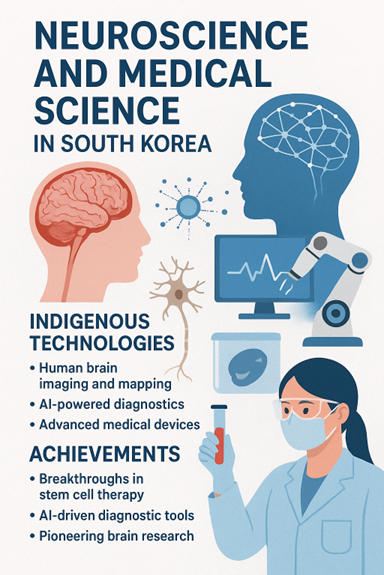
Over the passing time, south Korea has transformed itself from a healthcare dependent nation into a global medical leader in medical science and neuroscience. Combining strong government investment, academic excellence, and technological innovation, the country has built an advancement in the biomedical excellence that not only meets domestic healthcare needs but also contributes top global scientific progress. Its achievements span from brain research, cutting edge medical devices, regenerative therapies and AI-driven diagnostics- many of them powered by indigenous technologies.
South Korea’s success in neuroscience is spearheaded by institutions such as the Korea Brain Research Institute (KBRI), The Korea Institute of Science and Technology (KIST), and research-focused universities like Seoul National University, KAIST, And POSTECH. These centers have advanced understanding of brain structure and function, investigating neurodegenerative diseases such as Alzheimer’s, Parkinson’s, and dementia, which are significant concerns in an aging society.
A landmark project is the Korean Brain Initiative (K-BRAIN), launched to map neural circuits and develop brain-machine interfaces. South Korean scientists have designed indigenous high-resolution brain imaging tools, including next-generation functional MRI and optical neural probes. Such technologies are crucial for studying how the brain processes information and for developing new treatments for neurological disorders.
In medical science, south Korea’s journey is marked by its success in biosimilars and regenerative medicine. Companies like Celltrion and Samsung biologics have become global leaders in producing cost-effective biosimilar drugs for treating cancers, autoimmune disorders, and infectious diseases. This sector grew on the foundation of Korea’s own bioprocessing technologies, allowing it to compete internationally without depending on imported methods.
Stem cell research represents another area of indigenous strength. South Korea has developed patient-specific stem cell therapies for degenerative diseases and injuries, with notable contributions from institutes like CHA University and the Korea National Institute of health. These advances have opened new possibilities for treating spinal cord injuries, macular degeneration and certain of cancer.
In medical devices and diagnostics, south Korea has combined its prowess in electronics and IT with healthcare needs. The nation’s companies have developed homegrown technologies for high-resolutions MRI and CT scanners, robotic surgical systems such as the Revo-I (a domestic alternative to the U.S.- made Da Vinci robot), and wearable devices for real-time health monitoring. These innovations have not only improved accessibility and affordability but have also made south Korea a leading exporter of medical technologies.
AI-driven healthcare is rapidly expanding in South Korea. Start-ups and research groups have built AI-powered systems for early detection of diseases such as strokes, cancers, and dementia by analyzing imaging data, genetic profiles, and patient histories. Platforms like Lunit INSIGHT are now used internationally for AI-based radiology diagnostics. South Korea’s ability to integrate AI into routine healthcare illustrates the synergy between its medical science and information technology sectors.
Another notable area of development is precision medicine, particularly in oncology and rare diseases. The Korean Genome Project, which has sequenced hundreds of thousands of genomes, had enabled researchers to design targeted therapies based on genetic markers. Hospitals like Asan Medical Center and Severance Hospital are leading in applying genome-based treatments, demonstrating how medical science is becoming more personalized and effective.
Government policies have played a critical role in driving these achievements. Initiatives like the bioeconomy 2025 Strategy and the K-Bio and K-Medtech Roadmaps have provided funding, regulatory support, and infrastructure for research and commercialization. By promoting local innovation, these policies have helped south Korea reduce dependence on foreign medical technologies and build a strong domestic industry.
Looking ahead, south Korea’s priorities in neuroscience and medical science include the development of Brain-inspired AI, advanced neural prosthetics for patients with paralysis, and therapies for complex neurological disorders. There is also a growing focus on neuroethics to address questions arising from technological like brain-computer interfaces. In medical science, the country is expanding investment in next-generation cell and gene therapies, bioprinting of tissues and organs, and telemedicine platforms to provide equitable healthcare access.
South Korea’s achievements in these fields demonstrate how a nation can combine research, technology, and policy to transform healthcare outcomes and scientific understanding. By focusing on indigenous innovation, the country has built resilience against global supply chain disruptions and positioned itself as a hub for collaborative research and medical exports.
In conclusion, South Korea’s advancements in neuroscience and medical science highlight the power of science-driven innovation in improving human health and well-being. Through initiatives like K-BRAIN, stem cell therapies, AI diagnostics, and precision medicine, the nation has contributed solutions not only for domestic needs but also for the global scientific community. With continued investment and ethical governance, South Korea is poised to lead the next era of breakthroughs in understanding the human brain and delivering advanced healthcare.
Share it with your family and friends: