
Writer: Areeba Shafeeq
Editor: Arpita Jena
Introduction
AI stands for Artificial Intelligence. South Korea’s relationship with AI and technology has never been accidental. From semiconductors that power modern computers to consumer electronics used across the world, Korea has always planned its AI and technological growth carefully. Innovation deeply shapes and defines a country’s economic identity.
Picture Credit: PINTEREST
Here is a concise version with shorter, clearer sentences while keeping the meaning intact:
In the last decade, as the world moves closer to 2025, artificial intelligence has become central to South Korea’s long-term technology strategy. What makes Korea’s AI journey unique is not only its speed or scale of growth, but its purpose. South Korea does not view AI as a passing trend or a simple tool. Instead, it treats AI as national infrastructure. It is a foundational system that supports the economy and drives future development across industries, governance, and society. This clear intention is what makes Korea’s approach truly stand out.
A National Strategy: Infrastructure, Policy, and Scale
South Korea’s AI ambitions started with rigid infrastructure. In 2025, the Korean government announced a $5.1 billion partnership with Amazon Web Services to build a large AI-focused data center in Ulsan, that is supposedly to be completed by 2029. This project delivers a clear message ‘computing power is now as important as roads or electricity.

Picture Credit: THE KOREA HERALD
This push is supported by access to advanced AI hardware. Korean media reported plans to supply more than 260,000 Blackwell AI chips to South Korea. These chips will support government projects and major companies like Samsung, Hyundai, Naver, and SK Group. This is not only about increasing capacity. It shows Korea’s intention to secure a strong position in the global AI supply chain.
Governance is equally important. South Korea introduced the Framework Act on the Advancement of Artificial Intelligence and the Establishment of a Foundation for Trust. After the European Union, Korea came into the list of one of the first countries to introduce a comprehensive Artificial Intelligence law. The true aim is to balance encouraging innovation while confirming transparency, accountability, and public trust. This balance is one of South Korea’s greatest strengths.
Picture Credit: PINTEREST
The Role of Education and Talent Development
Infrastructure and policies alone cannot make AI successful without skilled human resource. South Korea understood this very well, which is why education and talent development are made crucial to its AI strategies. Many universities across the whole country are adding AI-related programs, research centres, and partnerships with industries into the education. AI is no longer limited to computer science only. It is being introduced in business, healthcare, manufacturing, and public administration studies.
At the same time, companies are taking interests in internal training programs to help already existing employees work effectively with AI tools and learn to use them better. This focus on learning reduces fear and avoidance for AI adaptation among workers and encourages them to collaborate instead of initiation a war between humans and machines. By preparing its workforce along with building technology, South Korea shows that people remain at the heart of innovation.
AI Adoption: Strengths and Structural Challenges
At the level of enterprise, South Korea presents a bigger picture. Large corporations have already adopted AI deeply, especially in manufacturing, logistics, and digital services. According to international organizations like the International Monetary Fund, AI usage among large Korean enterprises is higher than the global average.
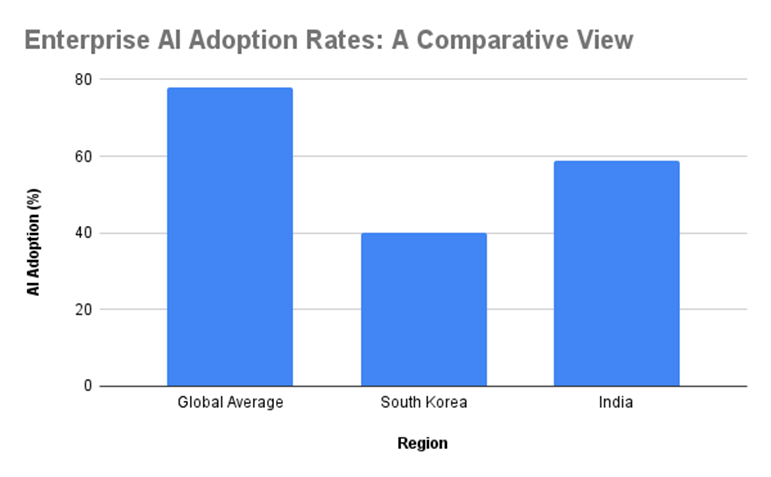
However, adoption among small and medium enterprises (SMEs) remains below. While around 40% of Korean firms use or explore AI, this level is similar to many other economies. The main challenge is not avoidance of technology, but preparing organizations for adopting AI. Many firms adopt AI tools without changing workflows or decision-making systems, which limits real overall productivity growth.
Social concerns also matter. There are ongoing discussions about job displacement, especially among labour unions. The focus is increasingly on upskilling the workers rather than making them a replacement. Despite these issues, public emotions remain mostly positive. Surveys also show that more than half of Koreans have used at least one AI application in the past year, showing the growth of accepting of AI in daily life.
Source: Areeba Shafeeq: Own Analysis
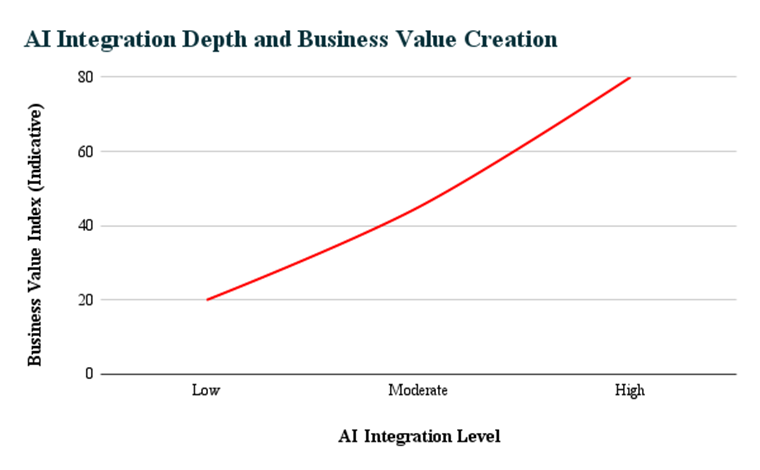
(This figure shows, Higher business value from AI is achieved when AI is integrated strategically across operations rather than used as isolated tools. The values shown are indicative and based on Global consulting and policy studies.)
This figure shows, Higher business value from AI is achieved when AI is integrated strategically across operations rather than used as isolated tools. The values shown are indicative and based on Global consulting and policy studies.
India’s Rapid Rise: A Complementary Contrast
India offers a strong contrast to South Korea’s approach. While Korea emphasizes precision, hardware leadership, and structured policy, India’s AI growth is driven by scale, talent availability, and fast experimentation. By 2025, India has emerged as one of the largest users of generative AI tools globally.
Surveys indicate that around 59% of Indian enterprises have already adopted AI, a higher portion than it is in South Korea. This boost comes largely from competitive sectors like fintech, telecom, and e-commerce, also supported by an IT workforce capable of rapid adaptation. According to Stanford University’s AI Index, India has improved its global AI ranking through stronger research output, policy development, and a growing innovation ecosystem.
Source: Areeba Shafeeq: Own Analysis
(This graph shows differences in enterprise AI Adoption, with India demonstrating broader usage across sectors, while South Korea emphasizes strategic and infrastructure-oriented deployment.)
This graph shows differences in enterprise AI Adoption, with India demonstrating broader usage across sectors, while South Korea emphasizes strategic and infrastructure-oriented deployment.
Global Influence and Future Outlook
South Korea’s AI journey is increasingly influencing many other nations. Its model of combining strong policy, trusted regulation, and close collaboration between government and industries is frequently studied by countries looking for sustainable AI growth. Instead of focusing on short-term gains, Korea focuses on long-term stability and impact.
As global AI competition increases, this approach may help Korea remain resilient and relevant. In the upcoming future, relationship between countries like South Korea and India could create powerful outcomes joining Korea’s structure and precision with India’s speed and scale. Such partnerships can help shape a more inclusive and human-centred global AI ecosystem.
Different Paths, One Core Lesson
Despite their different models, both South Korea and India highlight the same truth: AI creates real value only when used strategically. Studies reported by Business Insider show that globally, only about 5% of companies gain significant benefits from AI. These are usually firms that integrate AI into their core strategy rather than treating it as a stand-alone tool.
South Korea’s strength lies in long-term planning and industrial integration. India’s strength lies in adaptability and speed. Neither approach is better than the other they are responses to different economic realities. Most importantly, AI should not replace humans. True success comes when AI and human skills work together, side by side. That balance will define the future of artificial intelligence worldwide.
Share it with your family and friends:
Read more on our website:
The pace of innovation in Korea is mind-blowing! This article did a fantastic job of explaining how Korea is positioning itself as a leader in Al. Exciting to see what the future holds for tech in the peninsula.
Got useful information about technology in South Korea. Thank you.✨
An excellent article highlighting Korea’s advancement in AI and technology. The strategic approach and global impact were explained clearly. Very informative and relevant in today’s world!
AI and Technology in Korea
“Great breakdown of how Korea is leading the future—informative and forward-thinking!”
Interesting read! It shows how South Korea is focusing on long-term technological development rather than short-term gains
As Korea is one of the top country in research and innovation. AI plays a great role to make the country more modern than other countries. Korea doesn’t hype they ship. From semiconductors to K robots. No country can bet Korea in technology. Korea’s technology feels like they are already living in 2050. Korea claims that there will be 1 million AI trained professionals by 2030.
Very insightful. A great reminder that AI’s real value lies in strategic use and human collaboration.
Very well articulated and informative content.