
Writer: Isha Chaudhary
EDITOR : SHIVRAJ PATEL
South Korea is often called as the “Land of the Morning Calm“. It has become a shining example of technological innovation and cultural influence on the world stage. A country ravaged by war just a few decades ago now boasts one of the world’s most advanced economies.
In addition to demonstrating its soft power through the entertainment industry of “Hallyu,” or the Korean Wave (K-Pop, K-Drama), South Korea has emerged as a formidable force in key future industrial sectors, particularly telecommunications and automation. This country’s transformative journey not only tells the story of its economic growth but also demonstrates how visionary government policies and aggressive private sector investment can transform a nation into a technological superpower.
(image credit: Blomberg.com)
Unprecedented Leap in Telecommunications: Towards 5G and 6G
One of South Korea’s greatest technological achievements is its global leadership in telecommunications. The country was the first in the world to launch a commercial CDMA network in 1996 and 5G services nationwide in 2019. This early introduction of 5G gave South Korea a significant lead in connectivity.
5G Success and Impact
5G not only provided faster internet speeds in the country, but also laid the foundation for a comprehensive digital transformation.
Ultra-fast Speeds and Low Latency: 5G offers speeds up to 20 times faster than 4G. This speed and reduced latency have made augmented reality (AR), virtual reality (VR), and high-resolution streaming commonplace.
‘5G+ Strategy’: The South Korean government adopted the 5G+ Strategy, which aims to use 5G in 10 key industries, including smart factories, self-driving vehicles, and smart cities. This strategy establishes 5G as a core digital tool.
Infrastructure and User Base: The number of 5G base stations in the country has rapidly increased, and millions have adopted it, positioning telecommunications companies (such as SK Telecom, KT, and LG Uplus) to export their solutions to global markets.
Looking to the Future: 6G Leadership
Following its success in 5G, South Korea has now focused on its next ambition, 6G technology. The government has announced heavy investment in 6G research and development, aiming for its initial commercial launch by 2028. 6G aims to achieve 100 times faster speeds and microsecond-level latency than 5G, using the terahertz (THz) frequency band. 6G networks, combined with quantum communications and artificial intelligence (AI), will enable real-time holographic communications and the remote operation of complex robotic systems, ushering in a new digital world.
Automation Industry and the Smart Factory Revolution
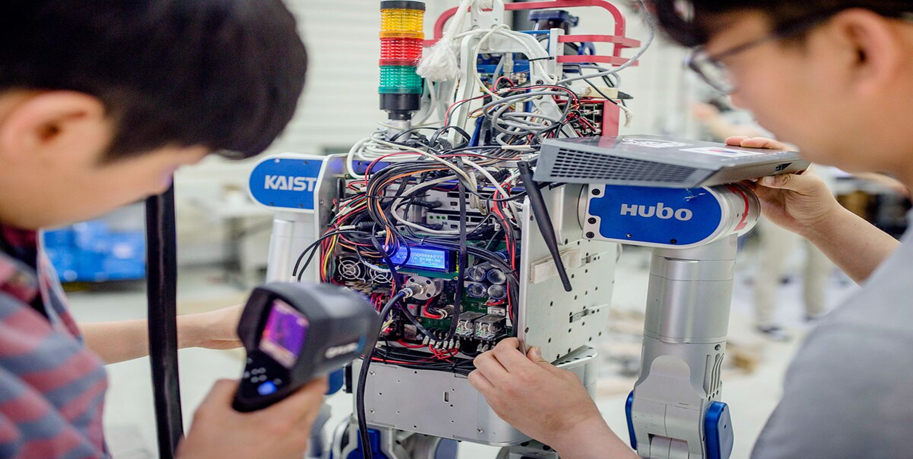
Parallel to telecommunications, South Korea is also a leader in automation and robotics. The automation industry has become a key pillar of the country’s manufacturing sector, enhancing the competitiveness of its economy.
Investment in Robotics
South Korea’s robot density (the number of robots per 10,000 employees) is among the highest in the world. This is a testament to the country’s deep adoption of automation in production processes.
Industrial Robots: Traditionally, the focus has been on industrial robots, which increase efficiency and precision on assembly lines. Large conglomerates (chaebols) like Samsung and LG see robotics as their future growth engine.
Growth in Service Robotics: Attention is now shifting from industrial robots to service robots such as collaborative robots (Cobots), logistics robots, and even coffee-making or frying robots. These robots are proving helpful in addressing workforce shortages in sectors such as healthcare, retail, and hospitality.
Smart Factory
‘Smart factories‘ are a crucial step in this wave of automation. These are production facilities that manage and optimize production in real time using the Internet of Things (IoT), AI, and big data analytics.
Efficiency and Predictability: Smart factories use real-time data to optimize production lines, predict failures, and reduce downtime by 20%.
Government Support: The South Korean government is investing significantly in AI-powered smart factories, aiming to take the country’s manufacturing to the next level of Industry 4.0.
Conclusion
South Korea’s rise in the telecommunications and automation industries is a global lesson in how strategic government policies, consistent investment in technological innovation, and rapid implementation can prepare any nation for the economy of the future. Leadership in 5G and progress towards 6G, as well as advances in robotics and AI-powered smart factories, ensure that South Korea will remain a powerful and influential player on the global technology stage for decades to come.
Share it with your family and friends: