
WRITER : GOURI ANAND KAKADE
EDITOR : SHIVRAJ PATEL
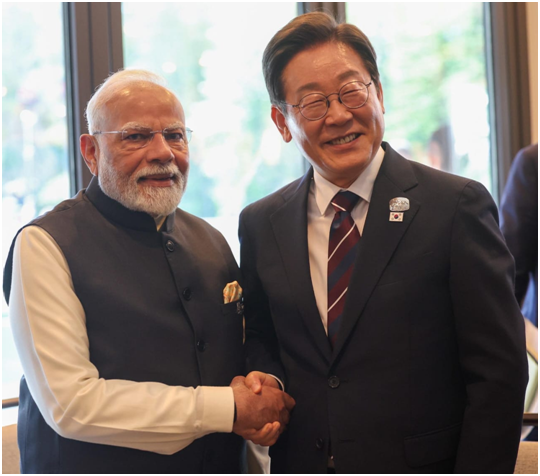
Picture Credit: Narendra Modi’s Instagram post @narendramodi
The relationship between Korea and India is characterised by a rich fusion of history, culture, spirituality, and evolving modern diplomacy. The relationship between India and Korea, which has a history dating back more than two millennia, shows both a deep respect for one another and a growing admiration for one another in the twenty-first century.
Historical and Cultural Relationships
India and Korea have a long history together, primarily because of their shared Buddhist faith. One of the most famous links is Buddhism’s journey from India to Korea through China in the fourth century CE. Indian monks like Bodhidharma and Sundo are believed to have spread Buddhist teachings widely, greatly influencing Korean philosophy, art, and culture.
One more fascinating myth that connects the two nations in the story of Queen Heo Hwang-ok, believed to have come from the ancient Indian kingdom of Ayodhya to Korea around in the 48 AD. According to the Korean chronicle Samguk Yusa, she married to King Suro of Geumgwan Gaya. This ancient story not only highlights an early marital alliance but has also led to establishment of symbolic ties Ayodhya and Gimhae (South Korea) are now sister cities, and a memorial for the queen exists in Ayodhya.
The transmission of the Buddhism led to the significant exchange of art and the literature. Korean Buddhist temples and sculptures reflect Indian influence in their architectural styles, iconography, and the philosophical themes. Traditional of Korean Buddhist paintings (Thangkas) and temple arts often carry depictions inspired by Indian deities and styles.
India, on the other hand, has adopted Korean cultural waves such as The Hallyu (the Korean Wave) which includes K-pop, K-dramas, Korean cinema, and fashion. South Korea’s cultural diplomacy and India’s openness to global art have helped create a bridge between the youth of both nations.
India and South Korea share economic ties between eachother. South Korea is an important investor in India, in major companies like Samsung, Hyundai, LG, and the Kia Motors contributing significantly to Indian employment and economy.
The Comprehensive Economic Partnership Agreement (CEPA), signed by in 2009, has facilitated trade and investment between the two nations. South Korea views India as a key partner in its “New Southern Policy,” and while India sees Korea as a the critical player in its “Act East Policy.”
Educational and Technological Collaborations
Indian students are also pursuing higher education in South Korea, especially in the fields of engineering, science, and cultural studies. Korean language is gaining popularity in India, and likewise, Indian classical arts, yoga, and literature are taught mainly in Korean universities.
There are some MoUs between Indian and Korean educational institutions, promoting academic exchange and the research of cooperation. India’s growing tech sector and South Korea’s leadership in innovation make this important area of the collaboration.
India and South Korea have increased cooperation in defense and security in recent years. They hold annual dialogues and consultations, and in 2019, both countries signed a military logistics support agreement, allowing better coordination between armed forces during joint exercises and the humanitarian efforts.
Cultural Exchange in the 21st Century
In recent years, both nations have embraced each other’s modern culture with enthusiasm. K-pop, Korean skincare, Korean language learning, K-dramas, and the Korean food have gained massive popularity in India. Events like Korea Fair in India, Korean Film Festivals, and Korean language contests are held regularly.
Similarly, Indian culture is celebrated in Korea. Yoga Day events, Bollywood film festivals, and Diwali celebrations are organized by the Indian community and supported by Korean institutions. The Swami Vivekananda Cultural Centre is in Seoul promotes Indian art, music, and culture actively.
India and Korea, as democratic nations with shared values of peace, development, and international cooperation, often find themselves aligned on the global issues like climate change, sustainable development, and digital economy.
India and the Republic of Korea (South Korea) established formal diplomatic relations in 1973, and the bond has only strengthened since from now.
In 2010, the relationship was elevated to “Strategic Partnership”, and in 2015, during Prime Minister of India Narendra Modi’s visit to Seoul, it was further upgraded to a “Special Strategic Partnership.” Both countries support each other’s interests on global platforms like the United Nations and have shared concerns over regional stability, maritime security, and peace of the Indo-Pacific.
India and Korea relationship is not just political or economical it is a rooted in deep historical respect, cultural connection, and a shared vision for the future. From the legend of Queen Heo to the beats of the BTS and the spirituality of Buddha to the Bollywood, the ties between the two countries continue to evolve in beautiful and meaningful ways.
As India and Korea walk together in the 21st century, their bond is a testament to how history and culture can shape strong modern partnerships, rooted in mutual admiration and endless potential.
Share it with your Family & Friends :
Would you be thinking about exchanging links?