
WRITTEN BY: AREEBA SHAFEEQ
EDITOR: PRACHI KANSHWAN
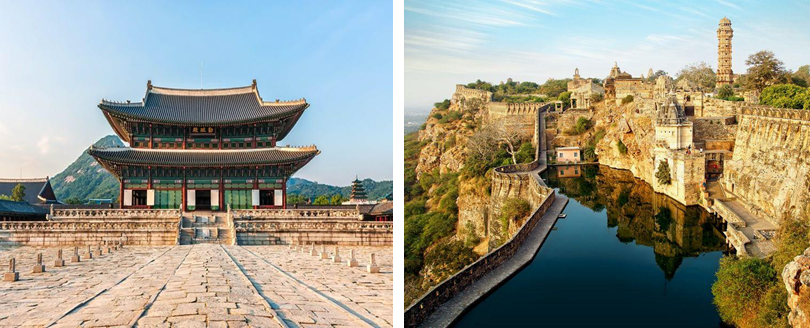
Gyeongbokgung palace, Seoul Chittorgarh fort, Rajasthan
Credit: Pinterest
South Korea’s history is not something that is confined to books or written in them. It is something alive in its places,from temples to folk villages, everywhere. Every street of Korea speaks its history. For millions of us around the world, though, our first introduction to these places often comes through the vision of Korean historical dramas (Sageuk).
Walking through the grand courtyards of Gyeongbokgung Palace in Seoul, or just standing and witnessing the serene grounds of Bulguksa Temple in Gyeongju. And you can sense centuries of tradition bound within these places. These are not just tourist attractions. These are the backdrops where history and storytelling meet, and form very beautiful stories to show in dramas. Dramas like Jewel in Palace (Dae Jang Geum), Moon Embracing the Sun, and even the globally acclaimed Kingdom have brought these sites to life on screen.
What makes these dramas powerful and memorable is how they blend the facts of history with feelings. Viewers witness Confucian hierarchies, court rituals, rules, family struggles, alongside themes of loyalty, betrayal, and love, the prestigious families, the old folks, everything combined in just one drama. These are universal emotions, wrapped in the elegance of hanbok, and framed against the ancient gates and temples of South Korea. One just doesn’t watch a drama; they can feel, and they can actually teleport into Korea’s history.
The beauty of authenticity lies in these dramas. Because when you see the towering gates of Changdeokgung Palace or the rustic charm of Hahoe Folk Village, you are not just looking at sets. These are UNESCO World Heritage Sites, preserved and presented as a living history for all the visitors across the world. They just don’t see the monuments; they see and live the history. Through these dramas, stones become reality and history gains a human voice, a story, and a connection to the people.

Jodha Akbar Moon Embracing the sun (해를 품은달)
Credit: Pinterest, Facebook
This idea of portraying history is not unique to South Korea itself. India, too, has long used cinema as a cultural bridge to its past. Movies and dramas like Jodha Akbar, Bajirao Mastani, or Padmavat showcase forts, palaces, and temples as well as the architecture. These are the characters in the story. The feelings and the way the story unfolds in front of the viewers.
Jaipur’s Amber Fort or Chittorgarh Fort, much like Korea’s palaces, are visual storytellers, a visual attraction to visitors across the world. But it has a hidden, long-lived history, and that history connects the souls of the people or the visitors to the beauty of its architecture. Both nations understand that history cannot just be preserved; it must be experienced, and only experiences last forever.
Beyond the grandeur, what ties Korea and India together are the humanity in these stories, the justice they do with these stories, while portraying the past and feelings into dramas and movies. A Korean drama like Moon Embracing the Sun tells the story of love torn by duty. An Indian viewer may recall similar tales of forbidden romance in royal courts. Likewise, India’s epics of sacrifice and justice reverberate with the Korean audiences. Across borders, we find that our ancestors shared the same longings, somehow the same love, loyalty, honour, and survival.
Historical dramas are not just simply entertainment; they are reminders that show, whether in Korea or India or any part of the world, the past is not just a distant memory or something that only happens in stories, but it is a living heritage and an unforgettable history. Watching these stories unfold, we realize it is not theirs or ours alone; it belongs to all of us, similar and prestigious, a shared inheritance retold with every generation. And these stories will relive its past, its history, and its heritage every time somebody asks us, “Why do we still watch these ancient dramas?“. To relive the essence of history that we never got to live.
Share it with your family and friends:
Xoso6688, huh? I’ve heard whispers. Feels like a fresh place to try my luck. I hope it brings me fortune! Check it out: xoso6688
3333betcom… The name’s got a ring to it! Never played there before, but I’m always up for a new betting spot. Fingers crossed! Give it a look: 3333betcom
4playbr, sounds interesting! Maybe I’ll give it a shot tonight – if I’m feeling lucky, who knows what might happen? My next stop: 4playbr