
WRITER – AISHWARYA PATTNAIK
Editor- ARPITA JENA
India and South Korea are two beautiful countries situated in Asia. Both countries shared vibrant culture, history, and traditions, and look after them religiously. On first glance, when someone thinks of the two countries, they will think of them as different from each other. No doubt it’s different though, but it shares many similarities as well. Both countries put strong emphasis on respecting elders, following rituals, and respecting their long cultural values. They have different languages and religions, but they share the same values when it comes to following their roots. Now, I want to discuss some similarities between both cultures.
1) Respecting Elders:
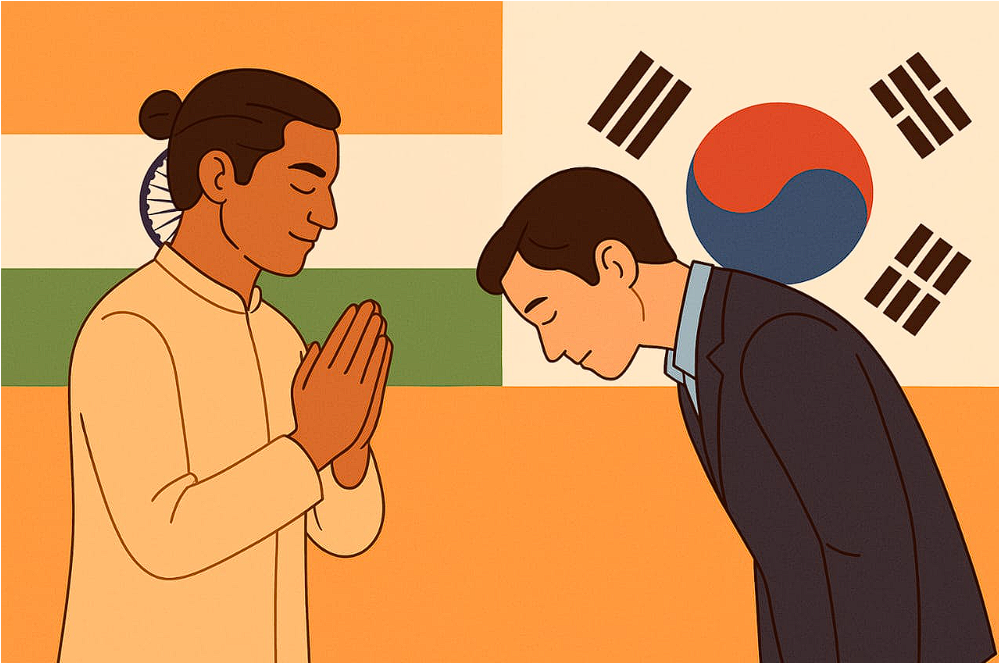
In India, we all respect our elders by bowing down and touching their feet or by doing Namaste. I remember when I was new to learn about Korean culture, these striking similarities came to my mind because in Korea, they bow down in front of elders whenever they meet, it’s their way of greeting elders. Even we use (aap) if we are talking to someone who is an elderly person, same thing in Korea they use 님 (nim), super respectful towards elderly person like 할 머니님(Halmeoni-nim).
2) Honoring Ancestors:
Both countries religiously follow this tradition of honoring their ancestors. In South Korea, a ritual called “Jesa” is a ceremonial rite prepared by family members to pay tribute to their ancestors. Usually, it’s held on their death anniversary. A table is prepared full of fruit foods and liquor, and it is offered in the name of the ancestors. Each item has its symbolic meaning and placement. Similarly, in India, “Pinda daan” and “Shraddha” are practiced, where they deliver fruits, pulses, dhoop, deep, and vegetables in the temple in the name of their “Pitra”, especially during “Pitru Paksha”. Both countries show their spiritual traditions and gratitude towards their roots.
3) Traditional Clothing:
Both countries have their respective traditional clothing, which they wear during some kind of festivals. In India, we wear a saree and dhoti, kurti and salwar kameez during celebrations and events. In Korea, they wear their traditional hanbok. These outfits are worn by generation and generations so that they will get reminded of their culture.
4)Family Centered Festivals:
South Korea have some major traditional holidays like Chuseok, Seollal. They all gather with their family members to celebrate it. Especially in Chuseok, they prepare a food called Songpyeon and moon cakes and share them with family members. Similarly, in India, we celebrate major festivals like Holi, Diwali, Dussehra, Pongal, and Sankranti with our family members. In both countries, when it comes to festivals, they share a connection, community and cultural continuity, and they celebrate it with full love and happiness.
5)Crafts and handicrafts as Cultural identity
Both countries have a deep connection when it comes to tradition and cultural identity. In Korea, traditional crafts were a reflection of their cultural soul, and it is deeply rooted in history. Art forms like hanji (handmade paper) and Minhwa (folk painting), and the clothing texture of Hanbok contain Korean appreciation for harmony, symbolism and ancestral heritage. These crafts reflect stories, history and folklore which is known from generation to generation. Similarly, India’s handicrafts carry the richness of its regional and spiritual significance. India has some prominent hand paintings like Madhubani and Pattachitra. Indian paintings depict the mythological stories and community wisdom. Both nations not just use these art forms for aesthetic purposes it is their cultural legacies that preserve identity and memories.
Conclusion
Despite being different countries in Asia, South Korea and India share a lot of similar rituals, which seems familiar. Similarities like Respect for elders, family traditions, ancestral rituals, spirituality and Crafts and art as a cultural identity. These cultural parallels show us that even in diversity, there is a connection. By exploring these similarities, we also build a strong relationship between both countries where both nations can create a global friendship, which will help in the growth and cultural exchange of both nations.
Share it with your friends and family :
Yo, 155betlogin, you’ve been my go-to lately. Smooth sailing and good vibes all around. Check ’em out! 155betlogin
Slotplus, what’s good? Honestly, decent selection and the bonuses are alright. Could be better, but I ain’t complaining too much. Give it a spin! slotplus
Okviptattantat, that’s a mouthful! Tried it out, seems legit. Definitely worth checking if the name doesn’t scare you off LOL. okviptattantat