
WRITER: ARPITA SINGH
EDITOR: NANDINI
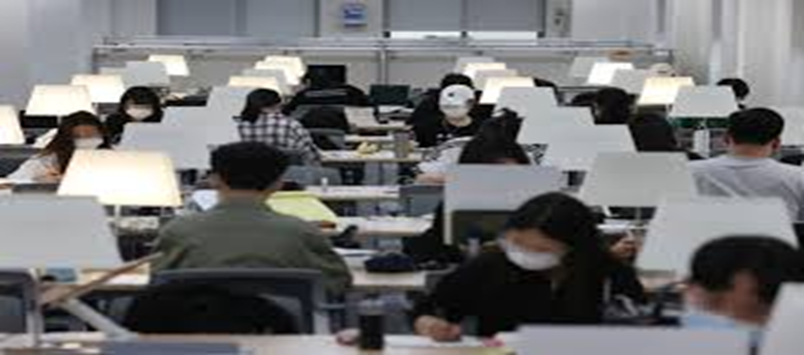
IMAGE CREDIT: KOREA JUNGANG DAILY
South Korea is now a world power, not only in entertainment and technology, but in education. Its meteoric rise from the ruins of war to become a top economy is one of single-minded concentration and tireless work. That same drive, however, has created an unusual and frequently high-stress existence for students and workers alike, an existence referred to on the ground as “the grind.”
The Study Marathon
The competition starts early. For South Korean students, there is only one objective: gain entry to one of the country’s best universities, the SKY universities (Seoul National, Korea, and Yonsei). Graduation from one of them is regarded as a straight ticket to prestigeous jobs and social mobility.
This sole-minded determination creates an educational environment unlike any other. The daily school schedule is only the warm-up act. The majority of students then go on to private academies, or hagwons, for hours of extra tutoring well into the night. Midnight returns are not rare. The “study marathon” reaches its climax in the Suneung, the national university entrance exam. On the day of the Suneung, the whole nation appears to be holding its breath. Flight routes are changed to avoid noise during the listening test, and office hours are modified to ensure students arrive on time. The eight-hour test is a defining moment that can put a stamp on a young person’s entire future.
This system generates highly disciplined and knowledgeable graduates, but at great expense. Levels of student stress are among the highest in the world, and issues related to the absence of creativity and work-life balance begin early.
The Corporate Ladder
Upon graduation, the grind continues to the next stage: joining the chaebols—the huge, family-owned conglomerates such as Samsung, Hyundai, and LG. These companies are the backbone of the Korean economy and the most desirable employers. Struggle for first-job ranks is intense, with a thousand candidates pining for a mere few openings.
Inside, the workers face a corporate culture imbued with tradition. Hierarchy is maintained at all costs, with Confucian teachings as a major influence. Respect for elders (seonbae) is obligatory, and decisions tend to come from the top down. The workday itself is long, but often the work spills over into the evening. Company meals, or hoesik, are standard fare. They are not social gatherings in any sense; they are an extension of the workday, where bonding with the team is mandatory, alcohol is frequently flowing, and junior workers are required to show up. Refusal is then interpreted as a lack of commitment.
This culture has generated the word kkwarŭngchan, or “gapjil,” meaning abuse of power by those in higher ranks. Although new social movements and new legislation are working to end these outmoded customs, they are still a reality for many.
A Shifting Landscape
Even in the face of persistent pressure, the terrain is irrevocably shifting. The “culture of overwork” is being challenged by a new generation. Young Koreans, known as the “N-po generation,” are formally rejecting the conventional trajectory of study, work, marriage, and childrearing because of the overwhelming economic and social burden.
Simultaneously, the job market is diversifying. The once-unshakeable allure of the chaebols is dimming for some. The rise of a vibrant startup ecosystem, particularly in tech hubs like Pangyo, offers an alternative. These companies often promise a more flexible, merit-based, and horizontal culture, attracting talent disillusioned with corporate rigidity.
In addition, the government has introduced legislative measures to enhance work-life balance. There is a law capping the lengthiest workweek at 52 hours (40 regular + 12 overtime) that is intended to stem the nation’s famous culture of working long hours and curb the dangers of gwarosa death through overwork.
Navigating the System
It is of particular importance to any foreigner thinking about studying or working in Korea. For students, it means preparing for a demanding, test-oriented educational system. For workers, it is dealing with a formalized corporate culture where networking, language skills, and being familiar with hierarchical relationships are precious commodities. Showing dedication and teamwork tends to matter more than brazen individualism.
The Korean grind is a testimony to the country’s amazing discipline and hunger for achievement. It is an approach that has yielded astonishing economic returns and international leaders. However, it is also a system in motion, struggling with the human toll of its ferocity. As a new generation remakes success, the future of the Korean grind will most likely be an intriguing mixture of its renowned work ethic and a new search for personal well-being.
Share it with your Family & Friends :