
WRITER : PRACHI SHARMA
EDITOR : SHIVRAJ PATEL
What happens when women become the storytellers of a nation’s soul?The world has been presented an answer in the form of South Korea. Today, almost 90 percent of the writers in the country are women. This figure is not only changing the culture of Korea but is redefining the definition of literature at the global level. And when the Nobel Literature Prize in the year 2024 was awarded to a South Korean woman writer, the whole world nodded to accept the reality that Korean literature today infused with the depth and nuance of women’s voices.
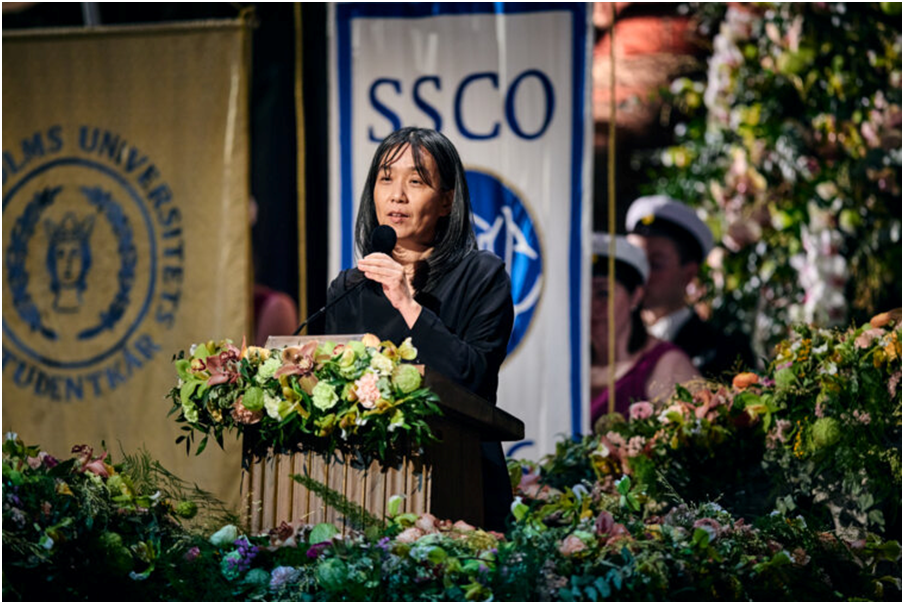
Picture Credit – Nobelprize.org
The journey from silence to voice
It is not so distant a time when the literature of Korea was in the hands of males. For centuries the voice of women was suppressed, patriarchal thinking limited their freedom to write and speak. However, in the latter half of the 20th century, when Korea advanced at lightning pace towards the modern world after emerging from war and sufferings, educational avenues opened up even to females.
This was the first time women grasped the pen in their hands and wrote about things never experienced till now. Household rivalry, gender discrimination, relationship complexities and experiences of broken lives started becoming a part of literature. For a space long dominated by males, women introduced a new revolution through their sensitivities and experiences.
Current situation: The women in charge
The scene is completely different today. The literary world in Korea is in the hands of women. Whether it is novels or poems or newer genres like web-novels the space is dominated by women. Han Kang (author of The Vegetarian) is just one among these names. There are hundreds of women today reaching and waking up the world and even Korea with their words.
Web-novels and other online sites empower women even more. Now they do not have to wait for the validation of anyone to be a publisher, in fact, they come to their audience directly. This gave even bigger scope to literature and women writers came forth in full strength.
“The 2024 Nobel Prize wasn’t just a personal triumph; it was a tribute to a generation of Korean women who’ve reshaped literature with courage and craft.”
The award is not just an appreciation of literary excellence but recognition of the fact that women are rewriting the very definition of literature. The Korean women writers have shown the world that their literature is not all about ‘women’s problems’. They express deep human sentiments and experiences.”
Literature is the mirror of society
Contemporary Korean literature is a mirror of today’s society. The books are authored primarily by women and thus bring into view a perspective never glimpsed previously. The books represent the pain of generations, the complexity of kinship relations, the difficulties faced by women in the workforce, and the fight against patriarchy.
Today’s girls recognize themselves in these stories and boys are no less affected by the reality and seriousness of these stories. The influence of literature is no longer limited to books but is equally visible in the story narratives of films and serials.
Challenges still remain–
Despite having greater numbers of women, numerous challenges are still remaining in criticism and recognition. The discrimination based on gender is even very noticeable within literary criticism. At the same time the popularity of novels on the internet typically imposes an added market pressure burden upon writers besides creativity.
But the women will never give in. The challenges are making them strong. They continue to write, rise, and redefine and demonstrating to the world that no one is going to take their right to tell these stories.
A glimpse into the future
The cultural capital of the world is South Korea if it is K-pop, dramas or movies. But it is all established on literature and it is the women holding it in the deepest ways.
The best is yet to come. The women will come to accept their awards but to give inspiration to the generations to come. Theirs are reminders of how Korean literature is vigorous and dynamic like a pulse and never static.
The literary revolution of Korea is no longer limited to the pages of books. It is a story of redefining history. When 90 percent of the writers are women, their pens intertwine emotions and revolution. The 2024 Nobel is proof that women from Korea are no longer writing literature, but establishing pillars toward legacy.
These women aren’t just writing books they’re rewriting history. In a world still grappling with gender inequality, South Korea’s literary landscape offers a luminous path forward: when women write, the world listens.
Share it with your family & friends :